MPL-2.0, operated in your cloud account
Downclimb is a graph-vector database for agent memory, and we run it inside your own cloud account.
The engine is MPL-2.0 and the data stays in the EU region you pick, on your bucket and your key. We take a restore point every six hours, restore one to a clone every Sunday, keep 30 days of point-in-time recovery, and run each upgrade as stages you approve and can step back from for 14 days.
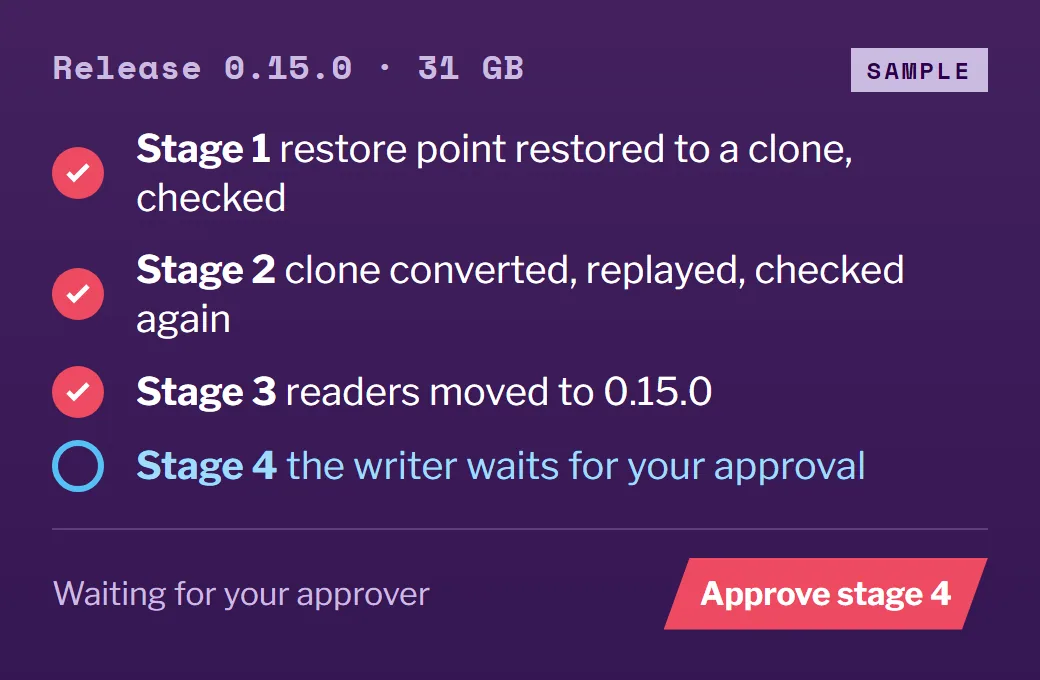
Sample: release 0.15.0 on a 31 GB memory database. Stages 1 to 3 done, the writer waiting for your approval.
Everything that holds your data sits in your account, and Frankfurt sees only counters and signatures.
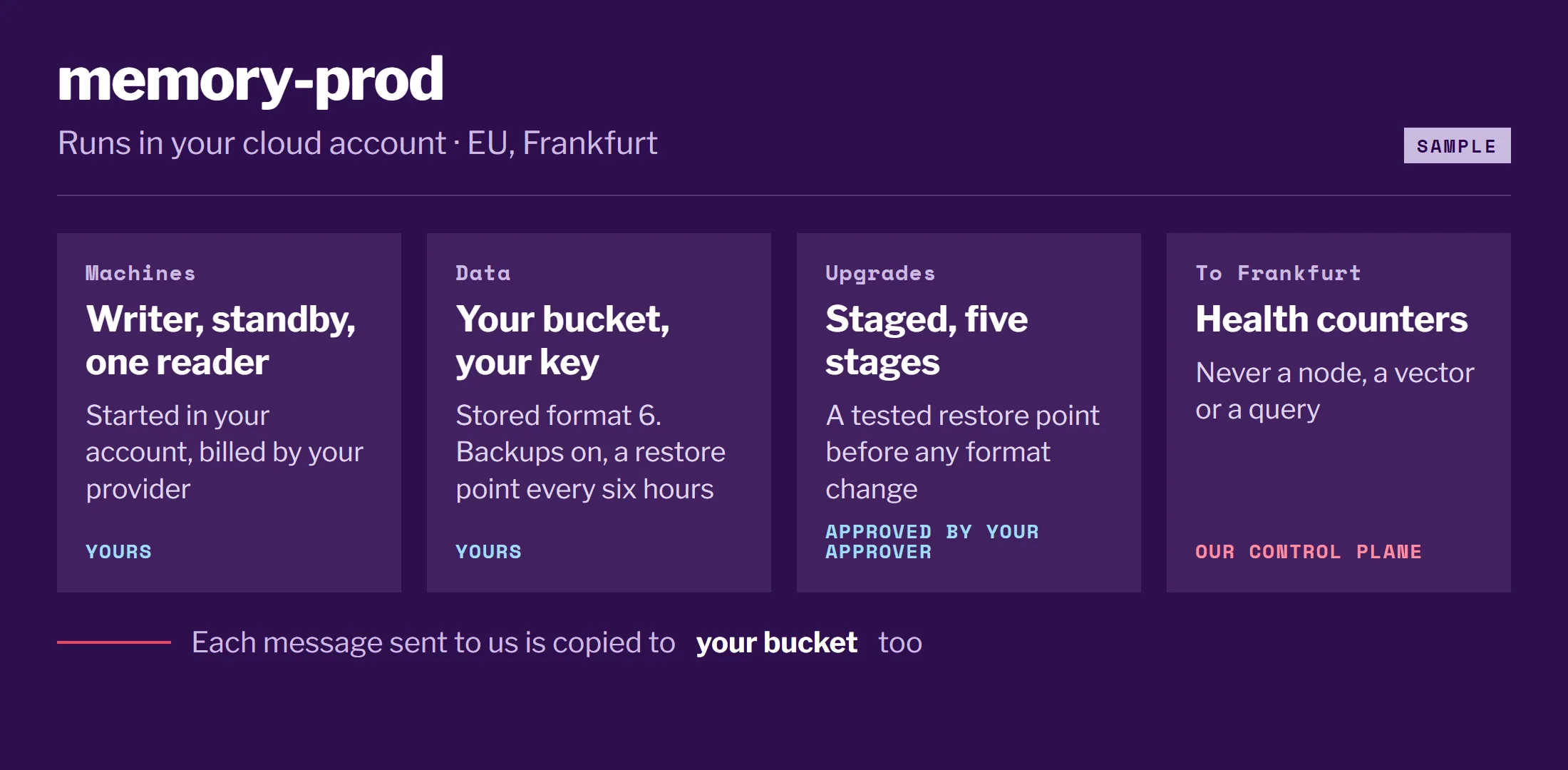
One operated database, part by part. The agent in your account checks every approval's signature itself and copies each message it sends us to your bucket.
- Your accountwriter, standby, readers, and the bucket holding the data
- Frankfurtour control plane, sending only stages your approver signed
- Before a format changea restore point, tested on a clone
- What crosseshealth counters, never a node, vector or query
14 daysthe database can still step back after the writer moves
A format change that only goes one way, kept two-way for 14 days.
What keeps it open is two things, both kept on purpose.
The tested stage 1 restore point stays in your bucket, with every log segment since.
No release moves the log format with the stored one, and new features wait for day 14, so every write replays on the old version.
This week's release notes
The fix you need ships inside a format change you cannot undo.
Take this week's release notes: the fix for searches that fail after a node is re-embedded and then deleted comes in a version whose first writer moves the stored format one way. Back up before changing the tag, they say.
On Downclimb a release of that shape is a page and five stages.
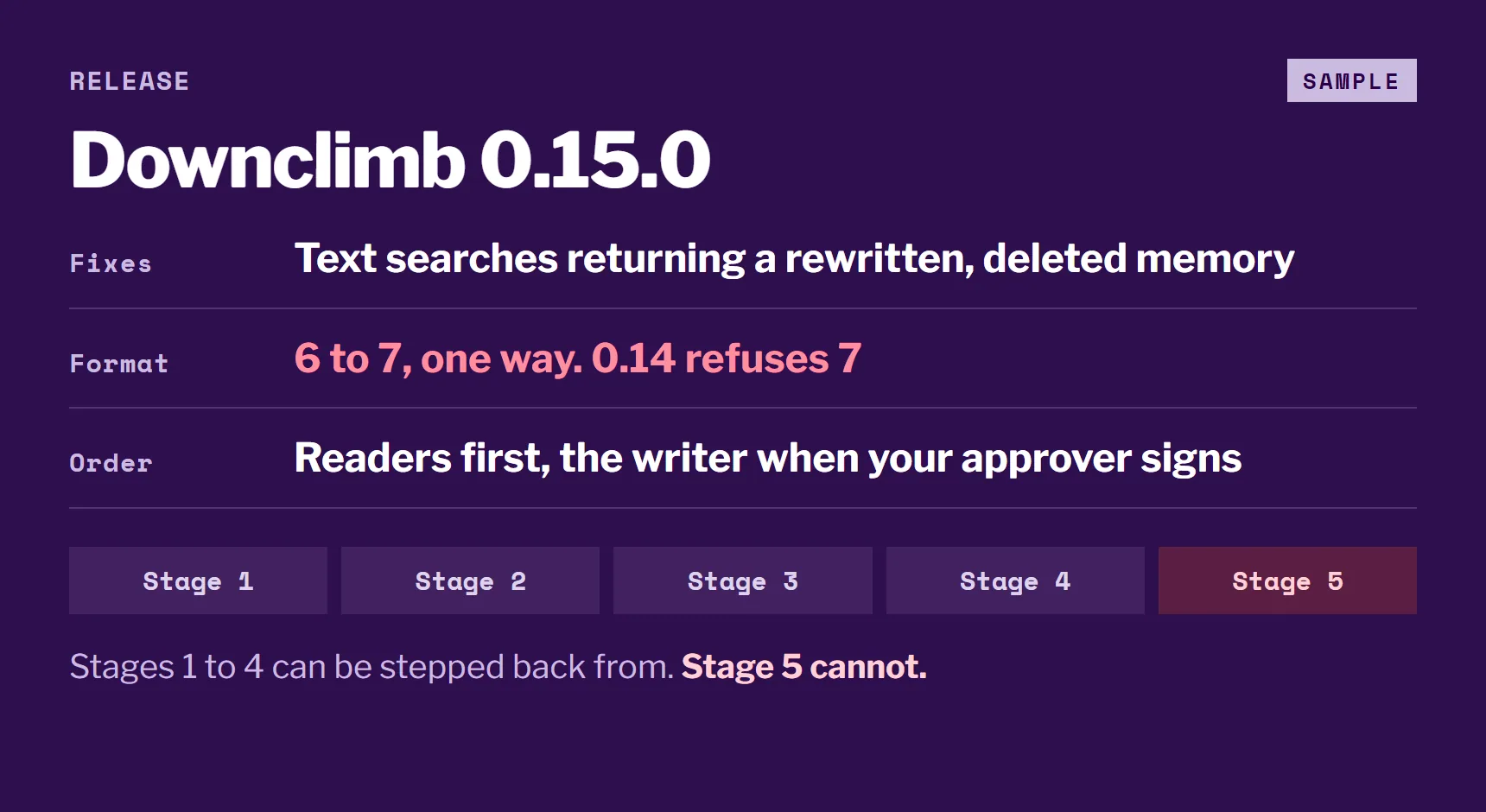
The page shows 0.15.0, Downclimb's own sample release, whose fix is in the text index.
- 0.15.0's fixtext searches stop returning a rewritten, deleted memory
- Its format6 to 7, and 0.14 refuses 7
- Its orderreaders first, the writer when your approver signs
Sample release page for Downclimb 0.15.0, five stages.
Which road to take from this week's release depends on what a bad upgrade would cost you.
On Downclimb, a bad upgrade costs a step back. Where you are now, without a backup you have restored, it costs a rebuild from source data and a second embedding bill.
Self-belay
€0; you schedule the drill and run each stage
Downclimb Self-belayOperated
€590 per database a month; we stage, your approver signs
What it costsStay put
right if a rebuild from source is a cost you can carry
Weigh staying put