One assistant's memory, kept in one store instead of a graph store and a vector store.
The other way is two stores: a graph database plus a separate vector extension, the pair one applied-AI job posting asks for, kept in sync by your own code. Downclimb keeps one copy.
Sophie is a node. Each fact she told the assistant is a node too, joined to her by a said edge.
Each fact's vector and text sit on its node, committed with its edges in one write.
Your app computes the embeddings; Downclimb never calls a model and does not rerank.
A search that starts at Sophie and ranks only what her edges reach.
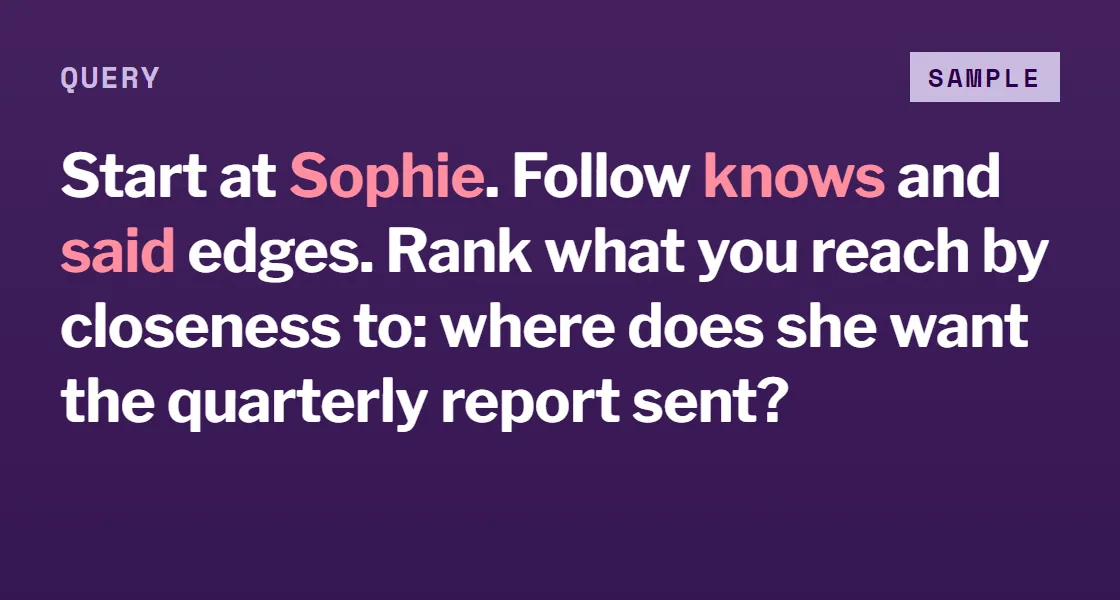
Ask where she wants the quarterly report sent. The query starts at her node, follows knows and said edges, and ranks what it reaches by closeness to the question.
A tenant property on every node, and keys bound to it, keep one user's memory out of another's results.
Up to 50,000 reached nodes are scored exactly; past 5,000,000 the query is refused.
- Wants the quarterly report as PDF to her work address0.91
- Asked for reports in German from October0.88
- Works from the Graz office on Fridays0.84
- Her assistant Tomasz collects printed copies0.79
- Moved the finance review to the first Monday0.74
- Prefers short summaries over full decks0.71
Four SDKs, LangGraph and Graphiti, and the embedding provider you already pay.
Each of these talks to the database inside your network. None of them sends anything to us.
- SDKsTypeScript, Python, Rust, Go
- LangGrapha long-term memory store
- Graphitia driver, group_id as tenant
- Your embedding providervectors arrive computed
- Object storageone bucket in your account
- Installcontainer image or Helm chart